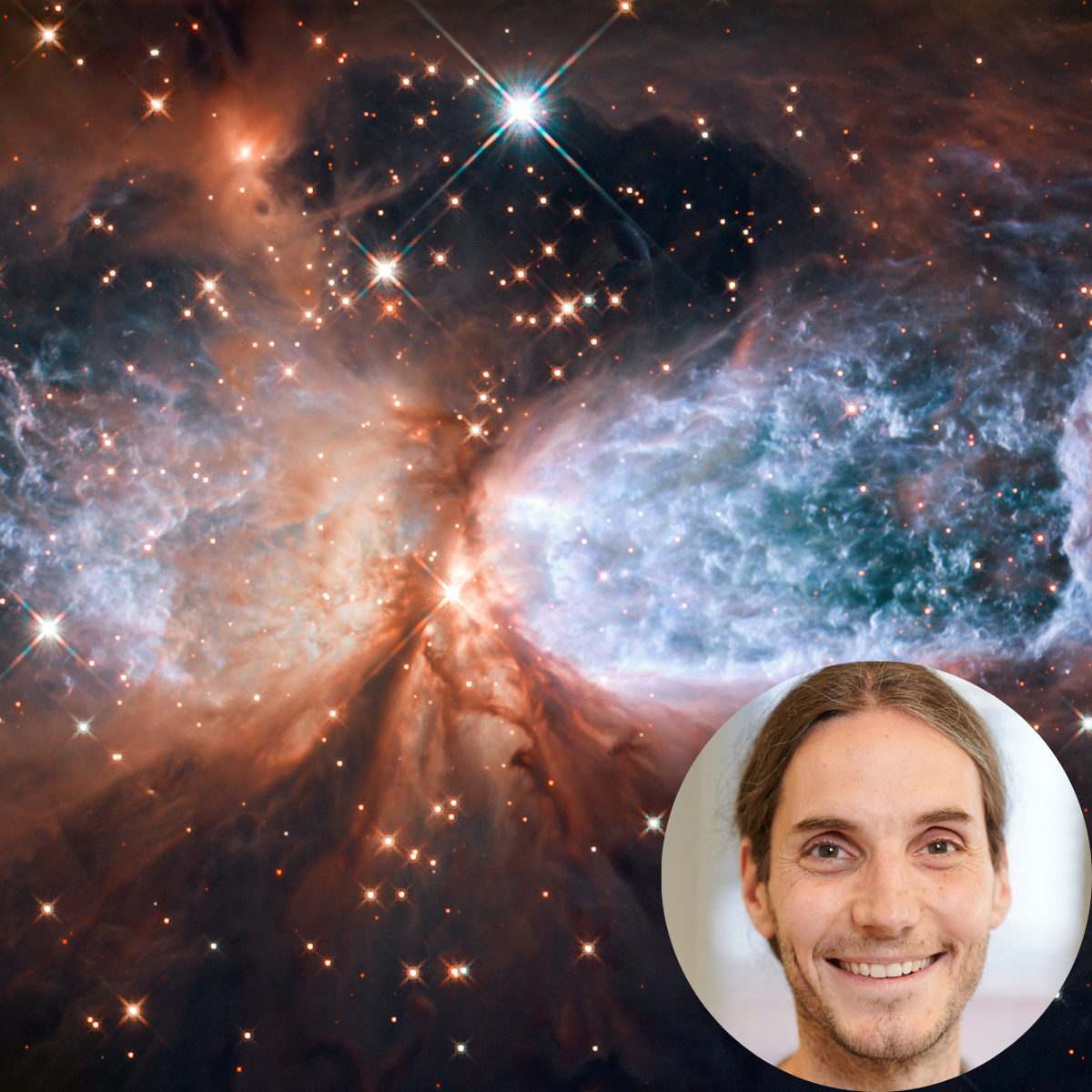
© Kuiper, NASA, ESA, STScI/AURA
Public lecture „Die Geburt stellarer Monster - Über die Entstehung der massereichsten Sterne im Universum “
We are pleased to invite you to the public lecture “Die Geburt stellarer Monster - Über die Entstehung der massereichsten Sterne im Universum " (in German).
In his talk, Rolf Kuiper will explore how the most massive stars in the cosmos are formed, which are rare in number, but extremely bright. He will connect the latest insights from astrophysical simulations with brand-new observations of young, massive star-forming regions that have only recently become accessible.
When 25.6.25 at 20:00
Where Planetarium Bochum
For registration and further information, please have a look at the Planetarium’s homepage.
Picture:
In the S 106 region, about 2,000 light-years from Earth, a particularly massive star is being born.
© Anna-Lena Lundqvist
Congratulations to Prof. Julia Tjus!
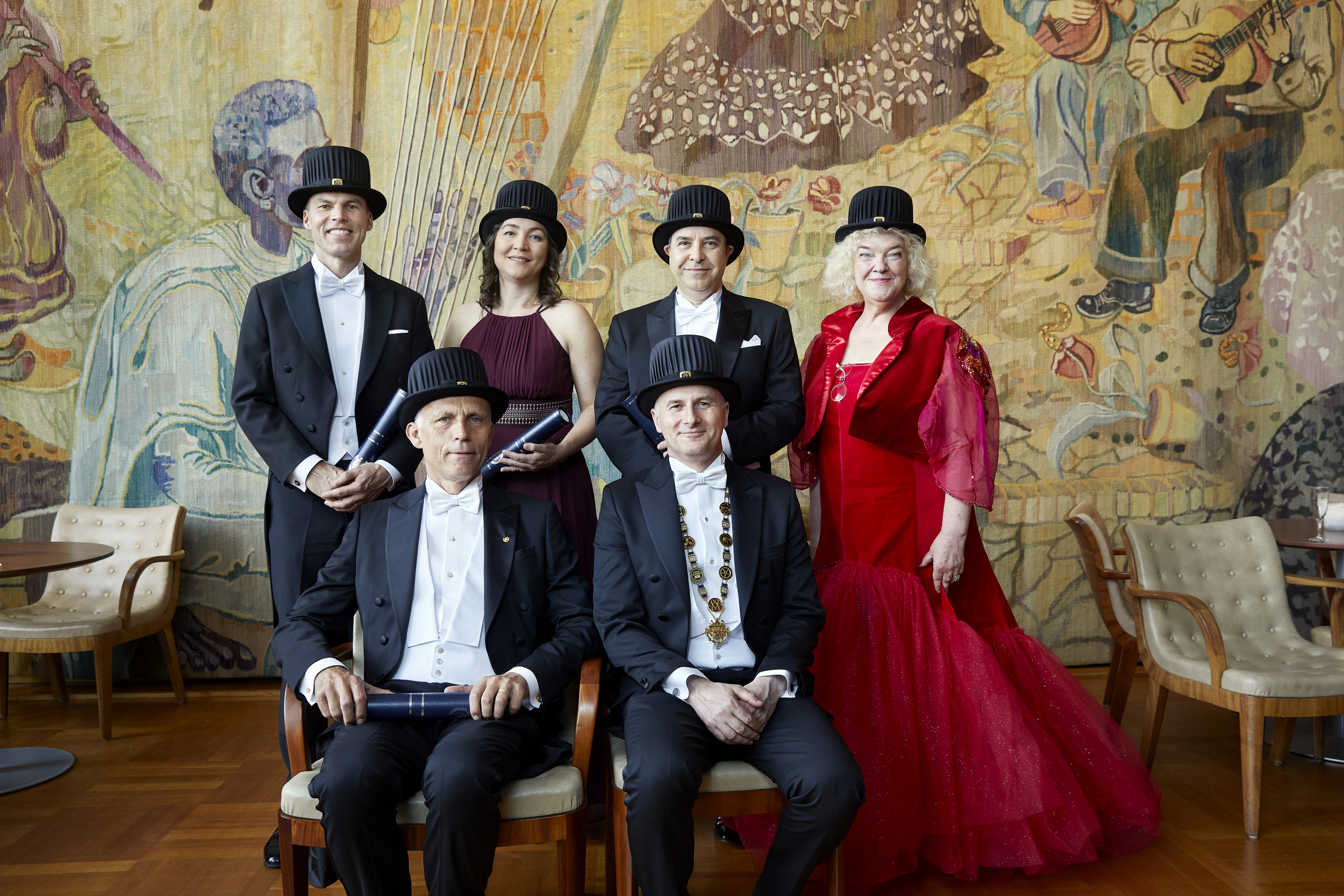
We are happy to announce that our spokesperson Julia Tjus has been officially named an Honorary Doctor of the Chalmers University of Technology as of May 24, 2025.
This prestigious recognition was awarded during the university’s annual academic celebration in the Gothenburg Concert Hall.
Julia has been honored for her groundbreaking contributions to astroparticle physics. Her pioneering work in neutrino astronomy and cosmic ray research, especially her collaboration with the IceCube Neutrino Observatory, has significantly advanced our understanding of the high-energy universe.
Since her postdoctoral stay in Gothenburg, she has maintained a close connection with Chalmers University. As a Jubilee Professor in 2023 and now as an Associate Professor, she continues to strengthen the strong partnership with Nordic radio and neutrino astronomy.
We also extend our congratulations to the new doctors of Chalmers University, the honorary doctors Babak Hassibi (CalTech), Herre van der Zant (TU Delft), and Marcus Wandt (Saab/Esa), and Chalmers Supervisor of the Year Yinan Yu.
Please also have look at the news articles of Chalmers
and RUB News
Picture:
All honorary doctorates: front: Herre van der Zant, Martin Nilsson Jacobi (President of Chalmers University), back: Marcus Wandt, Julia Tjus, Babak Hassibi, Eva Olsson (Chair of the Faculty Council)
© J. Tjus
IceCube Impact Award 2025
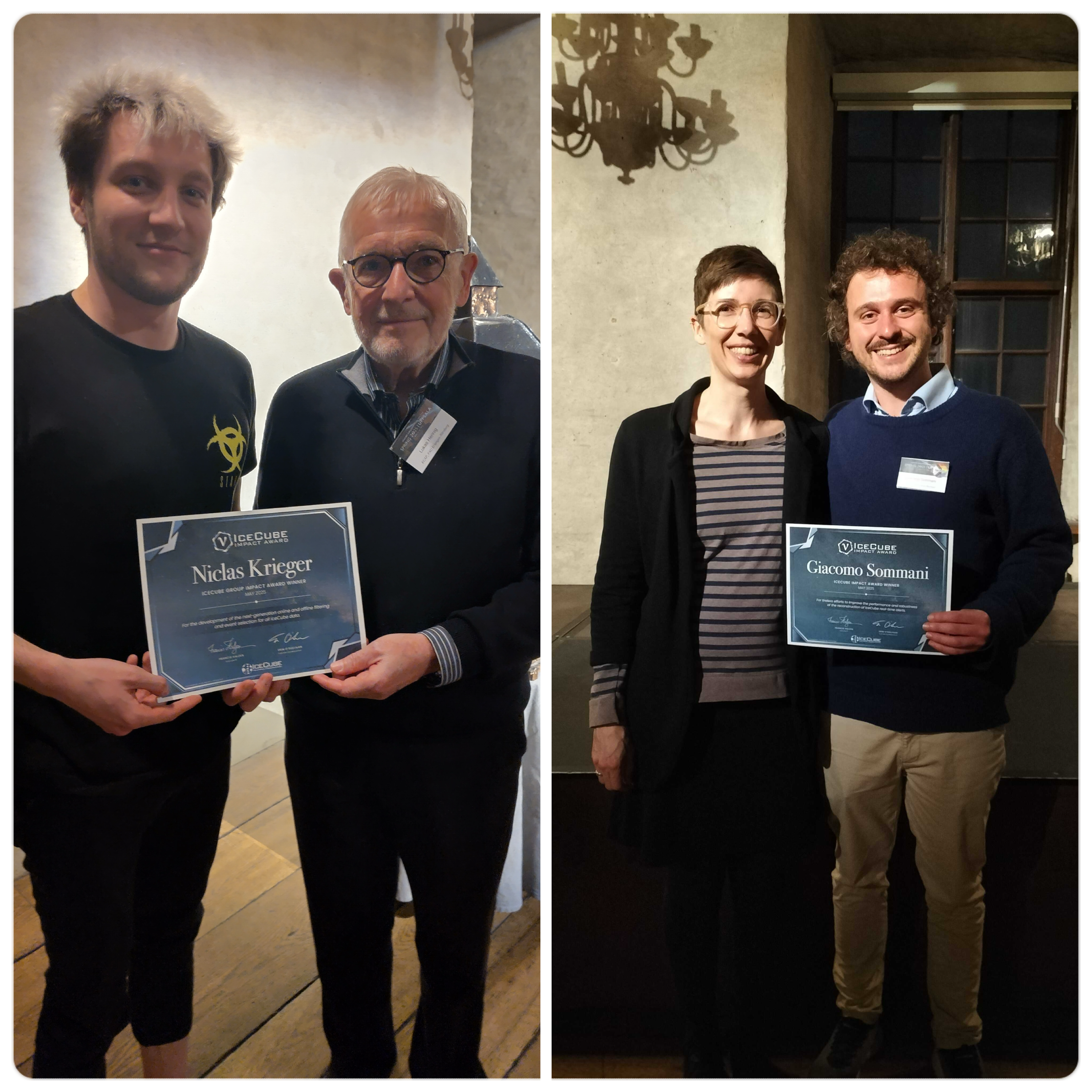
Congratulations to our SFB1491 members Giacomo Sommani and Niclas Krieger for receiving the IceCube Impact Award 2025!
The IceCube Impact Awards recognize significant contributions to IceCube - the neutrino observatory at the South Pole.
Giacomo received the Individual Impact Award for his outstanding work on the performance and robustness of the reconstruction of IceCube real-time alerts.
Niclas is part of the team that was honoured with the Group Impact Award for the development of the next-generation online and offline filtering and event selection for all IceCube data.
More information on the awards can be found
here
Picture: Niclas (left) and Giacomo (right) with collaborators.
© WSC
IDEA-2025 Science Slam winner: Sruthi Ravikularaman!
Congratulations to our new CRC associate and DARK100 postdoc Sruthiranjani Ravikularaman!
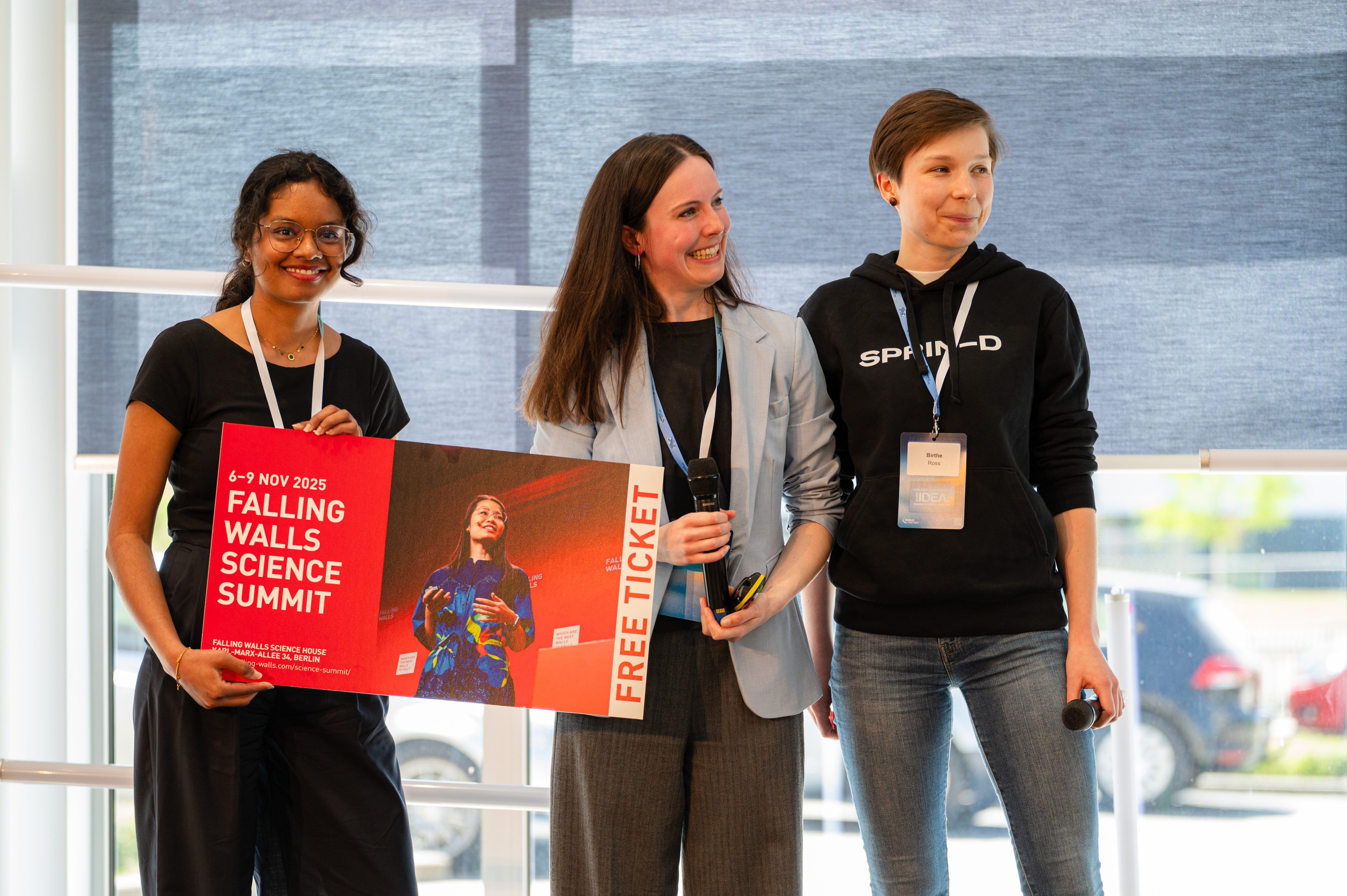
Sruthi won the Science Slam at IDEA.2025 — the first Entrepreneurship Day hosted by the Worldfactory Start-up Center (WSC) of Ruhr University Bochum!.
In her winning talk Afraid of the dark? she brilliantly explained the concept of dark matter using the analogy of ghosts. She also discussed the unique dark matter detection experiment of the Dark100 project with PANOSETI telescopes.
The judges praised her ability to address complex challenges in her field with a blend of humor and insight, making her presentation both informative and entertaining.
This award gives Sruthi the unique opportunity to attend the Falling Walls Summit in November in Berlin:
Read more about the IDEA.2025 event here
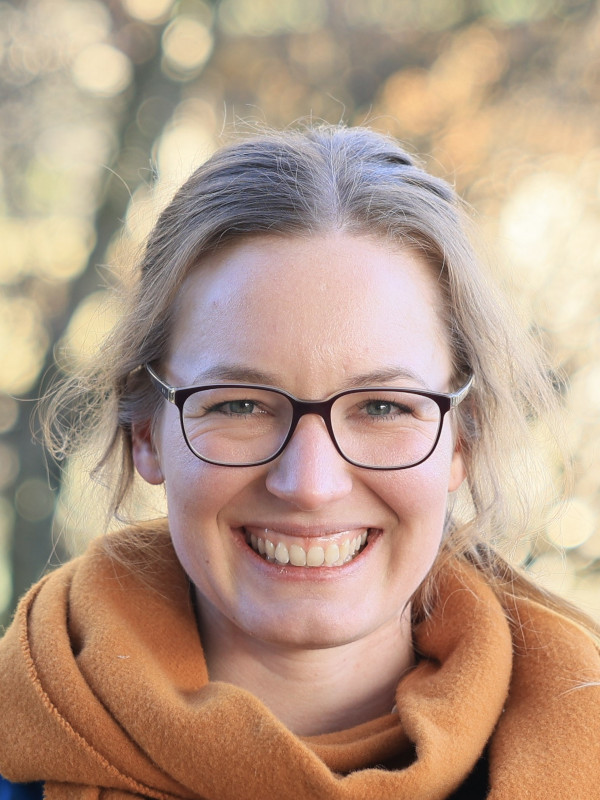
© S. Aerdker
Welcome to our new PI Sophie Aerdker!
We are excited to announce that Dr. Sophie Aerdker has been appointed as a new PI at our CRC.
Sophie is a PostDoc at the chair of Plasma-Astroparticle Physics, Institute for Theoretical Physics at RUB. She completed her PhD within the project A3 of the CRC, investigating cosmic-ray transport in the transition region between Galactic and extragalactic origin.
Her research focuses on high-energy particle transport in the presence of turbulent magnetic fields and acceleration processes, in particular diffusive shock acceleration. She is one of the developers of the open-source propagation framework CRPropa that is widely used in the CRC and a world-leading expert in modeling anomalous diffusion with stochastic differential equations.
From October on, Sophie will work with Martin Lemoine at APC in Paris. She will develop advanced models of particle transport applying stochastic differential equations to describe the complex motion of particles in magnetic field turbulence.
Sophie will continue studying particle transport in turbulent plasmas and apply stochastic models to investigate particle acceleration in various astrophysical environments. In the CRC, continuing the joint work of projects A3 and F1, she will extend the diffusive description of cosmic ray transport in the software framework CRPropa and investigate particle acceleration at non-relativistic shocks where the underlying microphysics will be informed by PIC simulations.